

Preconditioning-Activated AKT Controls Neuronal Tolerance To Ischemia Through The MDM2–p53 PathwayⅠ
Apr 23, 2023
One of the most important mechanisms of preconditioning-mediated neuroprotection is the attenuation of cell apoptosis, inducing brain tolerance after subsequent injurious ischemia. In this context, the antiapoptotic PI3K/AKT signaling pathway plays a key role in regulating cell differentiation and survival.

Active AKT is known to increase the expression of murine double minute-2 (MDM2), an E3-ubiquitin ligase that destabilizes p53 to promote the survival of cancer cells. In neurons, we recently showed that the MDM2–p53 interaction is potentiated by pharmacological preconditioning, based on subtoxic stimulation of the NMDA glutamate receptor, which prevents ischemia-induced neuronal apoptosis.
However, whether this mechanism contributes to neuronal tolerance during ischemic preconditioning (IPC) is unknown. Here, we show that IPC induced PI3K-mediated phosphorylation of AKT at Ser473, which in turn phosphorylated MDM2 at Ser166. This phosphorylation triggered the nuclear stabilization of MDM2, leading to p53 destabilization, thus preventing neuronal apoptosis upon an ischemic insult. Inhibition of the PI3K/AKT pathway with wortmannin or by AKT silencing induced the accumulation of cytosolic MDM2, abrogating IPC-induced neuroprotection.

Thus, IPC enhances the activation of the PI3K/AKT signaling pathway and promotes neuronal tolerance by controlling the MDM2–p53 interaction. Our findings provide a new mechanistic pathway involved in IPC-induced neuroprotection via modulation of AKT signaling, suggesting that AKT is a potential therapeutic target against ischemic injury. Keywords: AKT; MDM2; p53; PI3K; ischemic tolerance; preconditioning
1 Introduction
In humans, the existence of transient ischemic attack (TIA) has been revealed as an endogenous preconditioned state with the benefits of functional outcomes in stroke patients [1–3]. Endogenous neuroprotection induced by a short, subtoxic ischemic stimulus, known as ischemic preconditioning (IPC), is considered a strategy in the emerging field of neuroprotection against ischemic injury [4–6].
Evidence shows that IPC-promoted neuroprotection depends on transcription, translation, and post-translational mechanisms, which alters the function of key proteins after ischemia [6–11]. However, the mechanism involved in IPC-induced ischemic tolerance (IT) has not been fully clarified in the human brain [12,13].
The development of new experimental approaches to understanding IPC-mediated neuroprotection represents a powerful tool to decipher the endogenous mechanisms underlying brain IT [6], which have the potential to unveil novel therapeutic targets aimed at minimizing brain damage in stroke patients. In the last two decades, apoptotic neuronal cell death has positioned itself as an essential mechanism involved in cerebral ischemic injury [14–16]. In this sense, protein kinase B or AKT, a serine/threonine kinase that requires a functional phosphoinositide kinase (PI3K) to be activated, has been considered an essential target for neuroprotective therapies after ischemia [17,18].

Recently, we demonstrated that the inhibition of the PI3K/AKT signaling pathway increases neuronal susceptibility to excitotoxicity [19]. AKT is involved in a complex anti-apoptotic signaling network [20], whose components may be present at different subcellular locations depending on tissue type [21,22]. In the heart, AKT has been involved in preconditioning-promoted cardioprotection [23].
Evidence also shows that phosphorylated AKT promotes neuronal survival at the onset of cerebral ischemia [24]. Although AKT activation may contribute to the induction of IT in the brain [25], the exact mechanism involving its IPC-mediated activation remains elusive. In tumor cells, activation of the PI3K/AKT signaling pathway leads to MDM2 phosphorylation at Ser166/186, which promotes the nuclear translocation of MDM2 [26,27] and enhances its ubiquitination activity [28].
In the nucleus, MDM2 binds to p53 and promotes its ubiquitination and subsequent proteasomal degradation, which inhibits p53 function [29]. Under stress conditions, p53 could also trigger MDM2 overexpression, which conversely suppresses p53 activation in a negative feedback loop [30]. The inhibition of PI3K prevents AKT activation [31] and MDM2 phosphorylation in the preconditioned heart [32].
In this context, we previously found that in vivo brain preconditioning reduced infarct volume after transient middle cerebral artery occlusion (tMCAO) by increasing MDM2 protein level expression. Consequently, the MDM2–p53 complex attenuated ischemia-induced activation of the p53/PUMA/caspase-3 signaling pathway in primary cortical neurons [33].

Here, we dig into the role of the PI3K/AKT signaling pathway in IPC-mediated neuronal tolerance against a subsequent ischemic injury, as well as the underlying mechanism, and we mainly focus on the potential link between AKT activation and the MDM2–p53 complex.
2. Results
2.1. IPC-Promoted Neuroprotection
Is Mediated by Phosphorylation of AKT at Ser473, Phosphorylation of MDM2 at Ser166, and p53 Destabilization We previously described the impact of MDM2–p53 interaction on neuronal susceptibility to ischemia [34] and IT [33]. Here, we explored the potential role of AKT on IPC-mediated neuroprotection as a candidate to be involved in the MDM2–p53 pathway.
First, we confirmed that ischemia promoted AKT activation in neurons, as evidenced by AKT phosphorylation at Ser473. As shown in Figure 1A, short (20 min) OGD significantly induced p(Ser473)AKT and MDM2 expression, whereas AKT protein levels remained unaltered (Figure S1A). However, AKT phosphorylation was not observed when neurons were subjected to prolonged OGD (90 min). Moreover, MDM2 protein levels were lower, which is consistent with the higher expression of p53 protein as shown in Figure 1A.
The time-dependent upregulation of Mdm2 expression after OGD (Figure 1B) confirms that subacute ischemia may be important to induce mechanisms that prevent p53 stabilization after OGD, as previously described [33]. We used short OGD (20 min) followed by 2 h of reoxygenation as a model of IPC (Figure S1B) [33]; thus, we analyzed neuronal extracts collected at 4 h of reoxygenation after OGD (OGD/R) or after OGD preceded by the IPC protocol (IPC plus OGD/R). In parallel, neurons were incubated in normoxia (Nx) or preconditioning (IPC) settings (Figure S1B).
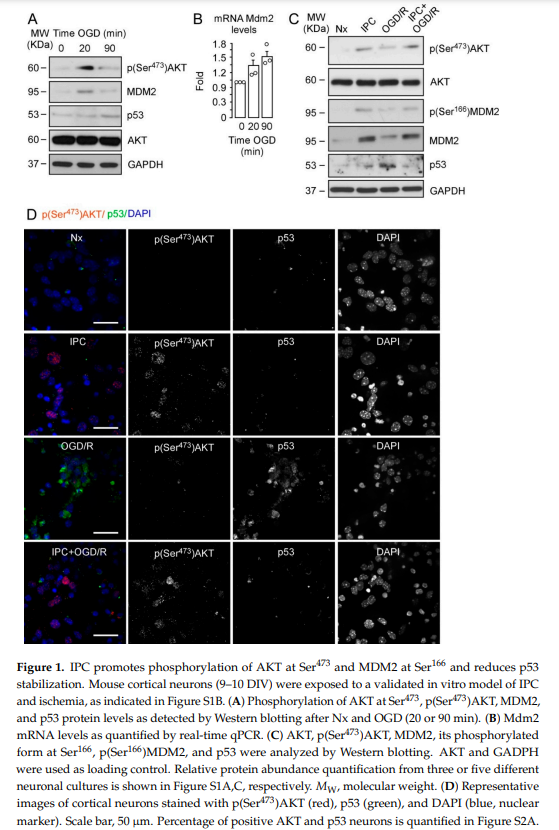
As shown in Figure 1C and Figure S1C, IPC induced the early activation of AKT, as revealed by phosphorylation at Ser473 [35], followed by MDM2 protein stabilization and phosphorylation at Ser166. IPC also prevented p53 stabilization induced by OGD/R (Figure 1C). Interestingly, immunofluorescence images shown in Figure 1D revealed that IPC promoted AKT phosphorylation at Ser473 in neurons, which predominantly accumulated in the nucleus, and decreased p53 stabilization after OGD/R (IPC plus OGD/R) when compared with non-preconditioned neurons (OGD/R).
Consequently, IPC prevented neuronal apoptosis and caspase-3 activation caused by OGD/R, as measured by flow cytometry (Figure S1D) and fluorimetry assays (Figure S1E), respectively. To confirm the role of p53 in IPC-mediated neuroprotection, we used neurons expressing (wild-type; wt) or not (knockout; ko) p53 protein. Our results show that neurons lacking p53 (Figure S1F) were more resistant to OGD-induced apoptosis than p53 wt neurons.
Moreover, apoptosis levels in p53KO neurons were similar to those observed in preconditioned (IPC plus OGD/R) wt neurons (Figure S1G), thus confirming the key role of p53 destabilization in IPC-mediated neuroprotection [33]. Our results show that IPC induced neuroprotection against an ischemic insult through a mechanism that involves phosphorylation of AKT at Ser473, MDM2 stabilization and phosphorylation at Ser166, and p53 destabilization.
2.2. IPC Triggers MDM2 Phosphorylation at Ser166 via the PI3K/AKT Pathway
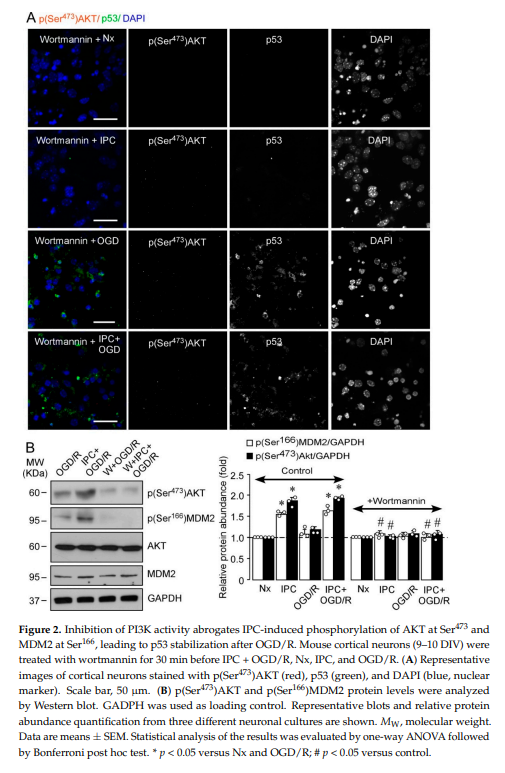
The PI3K/AKT signaling pathway is involved in neuronal IT both in vitro [36] and in vivo [37]. However, the role of IPC-mediated activation of the PI3K/AKT pathway in the regulation of the MDM2–p53 complex remains unexplored. To clarify this, neurons were incubated with the irreversible and specific inhibitor of the PI3K/AKT pathway, wortmannin [19].
As shown in Figure 2A, wortmannin abrogated IPC-enhanced (Ser473)AKT phosphorylation and p53 destabilization, as shown in Figure 1D. These results suggest a direct link between AKT activation and inhibition of p53-mediated neuronal apoptosis (Figure S1D) and caspase-3 activation (Figure S1E) induced after OGD/R. The main regulator of p53 stabilization, MDM2, is a target of AKT [26], which phosphorylates MDM2 at Ser166 and Ser186 [26]. PI3K inhibition with wortmannin prevented the phosphorylation of both (Ser473)AKT and (Ser166)MDM2 induced by IPC (Figure 2B).
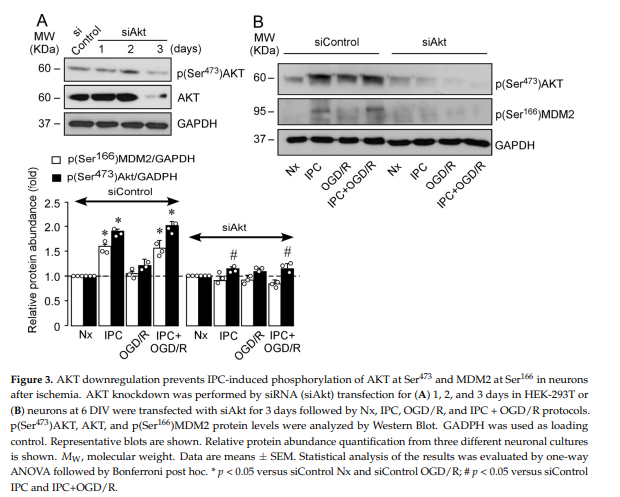
The specific Akt-mediated phosphorylation of MDM2 at Ser166 induced by IPC was confirmed by using a small interfering RNA (siRNA) specifically designed against AKT1 protein (siAkt), highly expressed in cortical neurons, and whose activity is essential for neuronal survival after ischemia [38]. As shown in Figure 3, siAkt reduced total AKT and p(Ser473)AKT protein levels at day 3 after transfection, both in HEK-293T cells (Figure 3A) and in cortical neurons (Figure 3B).
Moreover, AKT knockdown (siAkt) prevented (Ser166)MDM2 phosphorylation (Figure 3B). These results demonstrate that the IPC-activated PI3K/AKT signaling pathway promotes MDM2 phosphorylation at Ser166, which may be responsible for MDM2 stabilization and consequent p53 destabilization after ischemic injury.
2.3. IPC-Activated AKT Triggers Nuclear MDM2 Protein Stabilization after Ischemia
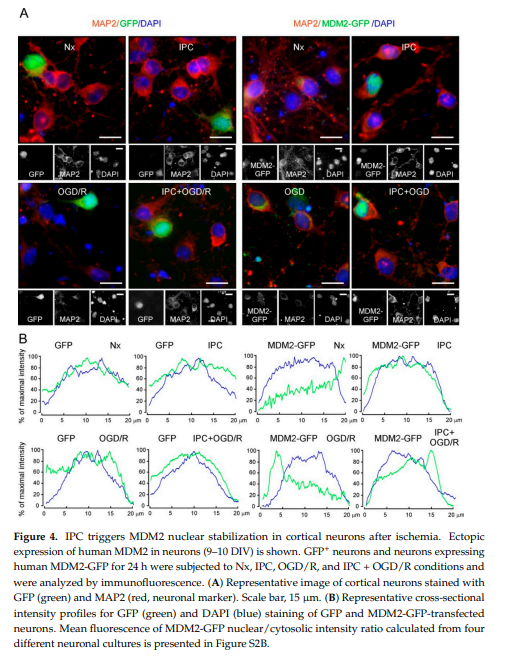
The activation of AKT has been involved in the nuclear translocation of MDM2 in tumor cells [26]. Considering the relevance of nuclear MDM2 stabilization for neuronal survival after ischemia [34] and, more specifically, its neuroprotective role in IPC [33], we decided to further investigate the relevance of PI3K/AKT signaling pathway in the regulation of subcellular localization of MDM2 protein.
Thus, neurons or HEK-293T cells were transfected with human MDM2-tagged protein (MDM2-GFP). Representative blots of transfected HEK-293T cells and images from neurons ectopically expressing human MDM2 protein after four different experimental conditions (Nx, IPC, OGD/R, and IPC plus OGD/R) are shown in Figure 4A and Figure S1H, respectively.
Ectopic expression of MDM2- GFP confirmed that IPC promotes MDM2 nuclear accumulation compared with nonpreconditioned ischemic (OGD/R) or normoxic (Nx) neurons (Figure 4A, B), as revealed by the quantification of nuclear/cytosolic fluorescence ratio (Figure S2B) and nuclear fluorescence intensity of MDM2-GFP (Figure S2C).
2.4. IPC Promotes p(Ser473)AKT and MDM2 Interaction, Which Enhances MDM2 Stabilization in the Nucleus and Reduces Induced Neuronal Apoptosis upon Ischemia
Following the demonstration of the role of IPC-enhanced activation of PI3K/AKT pathway in the nuclear stabilization of MDM2, we further investigated whether p(Ser473)AKT and MDM2 interacted within the nucleus (Figure 6A). MDM2 immunoprecipitation from nuclear protein extracts, followed by immunoblotting against MDM2 and p(Ser473)AKT, revealed that IPC promoted the interaction between p(Ser473)AKT and MDM2, after OGD/R, thus preventing OGD/R-induced nuclear p53 stabilization, as shown in the nucleus input (Figure 6A).

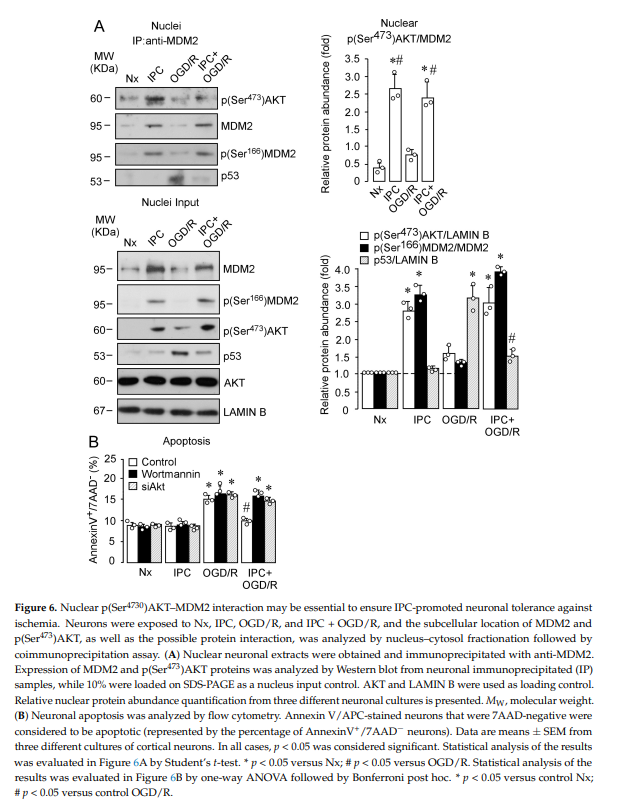
Lastly, we studied the detrimental effect of PI3K/AKT pathway disruption on neuronal apoptosis (Figure 6B). AKT inhibition counteracted the protective effect of IPC before OGD, which confirms the neuroprotective role of AKT–MDM2 in the context of IT. Our results, thus, demonstrate that IPC induces phosphorylation and activation of AKT, which promotes MDM2 phosphorylation at Ser166 and nuclear translocation, where it interacts with p(Ser473)AKT. This mechanism may contribute to enhanced nuclear stabilization of MDM2, which plays an essential role in IPC-induced ischemic tolerance.
In addition, Cistanche contains a number of bioactive compounds that have been shown to have neuroprotective effects. For example, it contains echinacoside, which has been shown to protect neurons from oxidative stress and inflammation. It also contains acteoside, which has been found to have anti-inflammatory and antioxidant properties.
Emilia Barrio 1,†, Rebeca Vecino 1,2,†, Irene Sánchez-Morán 1 , Cristina Rodríguez 1,2,3, Alberto Suárez-Pindado 1 , Juan P. Bolaños 1,2,3,4, Angeles Almeida 1,2,3 and Maria Delgado-Esteban 1,2,3,*
1 Institute of Functional Biology and Genomics, University of Salamanca, CSIC, 37007 Salamanca, Spain; emibg7@gmail.com (E.B.); rebecavecino@usal.es (R.V.); irene_sm@usal.es (I.S.-M.); c.rodriguez@usal.es (C.R.); Alsuap77@gmail.com (A.S.-P.); jbolanos@usal.es (J.P.B.); aaparra@usal.es (A.A.)
2 Institute of Biomedical Research of Salamanca, University Hospital of Salamanca, University of Salamanca, CSIC, 37007 Salamanca, Spain
3 Department of Biochemistry and Molecular Biology, University of Salamanca, 37007 Salamanca, Spain 4 Centro de Investigación Biomédica en Red de Fragilidad y Envejecimiento Saludable (CIBERFES), Instituto de Salud Carlos III, 28029 Madrid, Spain * Correspondence: mdesteban@usal.es; Tel.: plus 34-923-29-4908


